
Exploring Good Old-Fashioned AI (Part 1) — What I Learned from Cornell’s “Designing and Building AI Solutions” Program

This article is part of my learning series documenting Cornell University’s eCornell “Designing and Building AI Solutions” certificate program.
This article first appeared on LinkedIn as a LinkedIn article.
Introduction to Symbolic, Rule-based AI in Good Old-Fashioned AI (GOFAI)”
Continuing my journey through Cornell University’s eCornell “Designing and Building AI Solutions” program under Lutz Finger’s expert instruction, I dove into the 2nd module “Exploring Good Old-Fashioned AI (GOFAI)”. This follows after the first program module which is “Creating Business Value with AI”.
In this article, I will explore my key learning about symbolic, rule-based AI systems — foundational approach within the broad domain of GOFAI (also known as classical or traditional AI/ML).
This exploration of these early AI paradigms revealed valuable perspectives on systems that continue to play crucial roles in modern applications.
Understanding Rule-Based AI Systems as the First Wave of AI
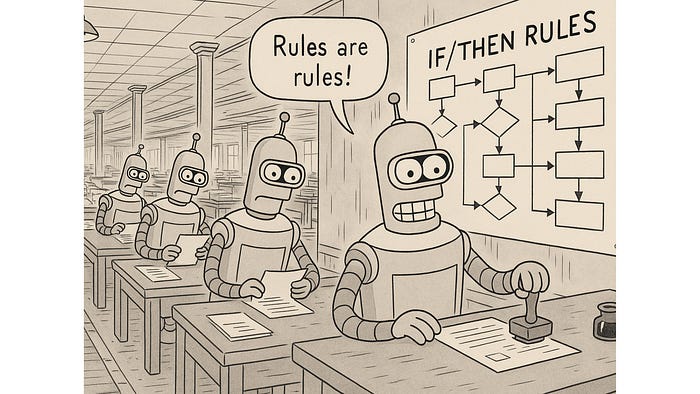
The first part of “Exploring Good Old-Fashioned AI (GOFAI)” module covers symbolic, rule-based AI and its transparent, logical frameworks for decision-making — a refreshing contrast to today’s often ‘opaque’ neural nets.
I gained appreciation for the elegance of systems built on fundamental components: clearly-defined symbolic representations, logical predicates, and IF/Then rules and logical connectives (e.g., Boolean operators). AI decisions in symbolic, rules-based systems are logical, transparent, interpretable and auditable.
This framework allows computers to perform logical operations based on human-defined or machine-learned rules — a process which I find elegantly simple yet powerful.
Practical Learning Through Exercises
In this “Exploring Good Old-Fashioned AI (GOFAI)” module, Lutz Finger had also designed particularly insightful exercises involving the development of rule-based systems to generalize to complex real-world scenarios (e.g., designing a robot waiter at a restaurant for every step, action and responses).
This hands-on work perfectly illustrated why purely rule-based systems struggle with generalization. The airport example was particularly powerful — air travel seems automated until something goes wrong (like a missing bag), then human intervention becomes necessary because we could not automate every possible scenario.
Knowing the capabilities and limitations of purely rule-based approaches helps me understand why successful modern AI often combines traditional symbolic methods with other machine learning techniques.
Insights from Yann Lechelle
A highlight of this module was the guest lecture by Yann Lechelle, a serial entrepreneur who shared valuable insights on integrating AI into business ventures. Lutz Finger had knew Lechelle from their INSEAD connection.
Lechelle’s discussion about NetVestibule (a social networking platform for admitted students at business schools) demonstrated how even simple data analysis could provide valuable business insights — like predicting which admitted students would actually enroll based on their platform engagement.
He also emphasized the importance of domain knowledge alongside technical skills, advising students not to discard their non-technical backgrounds when entering the technology field.
Enduring Relevance of Symbolic, Rule-Based AI in Modern Systems
Symbolic Rule-Based Systems as the First Wave of AI: The Cornell program’s exploration of symbolic, rule-based AI fundamentals sparked my curiosity about the approaches in today’s rapidly evolving AI landscape. What I learned is that symbolic, rule-based AI — the very first wave of AI — remains surprisingly relevant even in modern AI systems, including the large language model-based systems and other generative model-based systems that we see today. This approach, characterized by explicit symbols, logical predicates, and IF/THEN rules, provides the deterministic decision-making framework that makes today’s AI systems reliable and trustworthy.
From Human Intuition to Deterministic Business Rules: One key insight from the module was understanding that while humans operate with intuition, business decisions require deterministic yes/no decisions for causality, consistency and auditability. Symbolic, rule-based AI provides this reliability by using explicit cutoff values to transform uncertain situations into discrete categories — exactly what businesses need for clear, auditable decisions that can be explained and defended.
Why Rules-Based Symbolic AI Remains Indispensable in Businesses: Businesses and enterprise applications demand interpretability, reliability, and deterministic behavior, which rules-based symbolic AI provides, while neural networks contribute contextual understanding and natural language processing. The persistence of rules-based symbolic AI in modern systems is not nostalgic — it is necessary. The complexity of modern AI guardrails requires sophisticated solution design methods to manage multiple, sometimes conflicting requirements that pure neural approaches cannot reliably handle. Rules-based symbolic AI provides the structured framework that ensures AI systems remain controllable and auditable. Modern AI systems increasingly implement hybrid architectures where rules-based symbolic AI and neural components work together synergistically. These systems leverage the predictability and reliability of first-wave approaches for critical decision points while using neural networks for natural language understanding and generation tasks. This addresses real-world requirements for controllability, auditability, and deterministic behavior that make AI systems trustworthy in production environments. Enterprise applications specifically demand:
Interpretability: Clear explanation of how decisions are made
Reliability: Consistent behavior across scenarios
Deterministic Control: Predictable responses for business-critical decisions
Auditability: Traceable decision paths for compliance
Symbolic, rule-based AI delivers these requirements through explicit logic that humans can understand, modify, and trust.
Complementary Approaches between Rules-Based AI and Machine Learning: What surprised me most was learning that the most sophisticated AI systems today are not purely neural nets (or neural networks). As explored in the paper ‘Neurosymbolic AI: The 3rd Wave’ (https://arxiv.org/pdf/2012.05876), the integration of symbolic reasoning with neural approaches represents the next evolution in AI development.”
These hybrid AI systems are carefully designed combinations where:
Symbolic, rule-based AI provides reliability, control, and interpretability
Machine learning handles pattern recognition and probabilistic predictions
This hybrid approach also addresses real business needs for AI systems around nuanced pattern recognition, reliability, control, and interpretability.
Where Rules-Based Symbolic AI Powers Modern Systems: Through my learning from the program coursework, I learned key areas where first-wave AI principles remain essential till today:
1/ AI Safety and Control Systems: Modern AI guardrails use classic rules-based symbolic logic, applying IF/THEN rules to monitor and control AI outputs within defined business and safety boundaries. Contemporary guardrail systems implement what researchers classify as neural-symbolic architectures — essentially evolved GOFAI systems that incorporate neural components:
Type 1 Neural-Symbolic Systems: Like Llama Guard and NeMo Guardrails, where “the input and output of a learning agent are symbolic” — pure GOFAI input/output with neural processing
Type 2 Neural-Symbolic Systems: Like Guardrails AI, which “consists of a backbone symbolic algorithm supported by learning algorithms” — GOFAI architecture enhanced by neural capabilities
2/ GOFAI Languages Powering Modern AI:
RAIL (Reliable AI Markup Language): Used by Guardrails AI as “a language-agnostic and human-readable format for specifying specific rules and corrective actions for LLM outputs” — classic GOFAI principles applied to modern AI systems
Colang Programming Language: NVIDIA’s NeMo Guardrails employs this “executable programme language designed to establish constraints and guide LLMs within set dialogical boundaries”
3/ Business Process Automation: When companies need consistent, explainable decisions — like routing customer requests, validating data formats, or enforcing compliance rules — they rely on symbolic rule systems rather than neural networks. This ensures predictable, auditable outcomes that businesses can trust.
4/ System Coordination and Workflow Management Complex: AI applications often involve multiple components working together. Rules-based workflow management — using the same symbolic logic principles from first-wave AI — orchestrates these interactions reliably and predictably.
5/ Modern Communication Protocols are also Rule-Based: The growing interest in AI agents has sparked development of communication standards like Anthropic’s Model Context Protocol (MCP) and Google’s Agent-to-Agent (A2A) protocol. While these are infrastructure and communication protocols rather than AI reasoning systems themselves, they demonstrate how rules-based structures remain essential for building reliable AI systems that can work together effectively. These protocols use the same symbolic representation and rule-based principles that also define symbolic, rule-based AI.
Setting the Stage for Machine Learning: Understanding symbolic, rule-based AI as the first-wave in this Cornell program is not just historical knowledge — it is fundamental to appreciating why machine learning emerged as a complementary approach. Where rules-based systems excel at control and interpretability, machine learning excels at pattern recognition and generalization from data. Rather than being replaced by neural networks, rules-based symbolic AI has evolved to become the essential control infrastructure that makes modern AI systems reliable and safe. We will explore how these foundational symbolic approaches combine with machine learning techniques to create more adaptive and powerful AI solutions.
In my next article, I shall cover my learning and reflections about machine learning — the second wave of AI that learns patterns from data rather than following pre-programmed rules. Together, these approaches form the foundation of modern AI systems that are both intelligent and trustworthy.
Real World Example: Applying Symbolic, Rule-Based AI to TalentSol
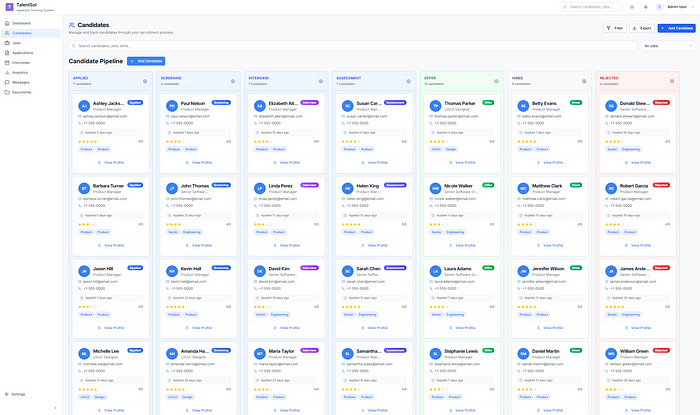
The technical implementation is available on my GitHub: https://github.com/youshen-lim/TalentSol---Applicant-Tracking-System-Application
Building on my previous article, TalentSol serves as my hobbyist AI/machine learning project developed with Augment Code — though I should clarify that while the technical implementation is real, the applicant tracking system itself is hypothetical rather than a deployed business solution. This project fulfills two key personal objectives:
1/ I was curious about using AI tools like Augment Code Agent for highly efficient code generation and application development. Call it “vibe-coding” but you still have to understand application architecture designs for frontend and backend development. Brian Foote once said, ‘If you think good architecture is expensive, try bad architecture.” Nevertheless, it is very impressive to have Augment Code as a AI development partner and ‘fractional CTO’ to execute frontend and backend development. For a non-professional coder like myself and entry-level engineers, this democratization of code development is a huge leap in efficiency.
2/ I had to create an actionable user interface for my machine learning models that would otherwise remain command-line experiments using Python. I am dedicated to the full-stack development, which takes more effort and time beyond a Kaggle data project.
The technical implementation is available on my GitHub: https://github.com/youshen-lim/TalentSol---Applicant-Tracking-System-Application
Despite being a hypothetical system, TalentSol provides an ideal case study for implementing symbolic, rule-based AI principles because recruitment decisions inherently follow logical frameworks that align naturally with the deterministic, transparent nature of rule-based systems.
Applying Symbolic, Rule-Based AI to Recruitment: Even in this hypothetical context, the business logic remains compelling.
Recruitment decisions follow clear logical patterns like “If candidate has X years of experience AND possesses required skill Y AND meets visa requirements, then prioritize for review.”
This natural alignment between business logic and IF/THEN rule structures makes TalentSol perfect for exploring how first-wave AI methods deliver transparent, auditable decision-making.
Unlike some of the other “black-box” AI approaches, symbolic AI systems provide the explainability that any real HR team would need — every decision can be traced through clear logical steps, ensuring regulatory compliance and building trust with candidates & hiring managers.
Practical GOFAI Implementation Approaches: I identified several implementation examples for symbolic, rule-based AI that leverage its transparent, deterministic nature.
These GOFAI solutions can provide immediate business value while maintaining the explainability that modern HR users, systems and workflows need.
Of course, these approaches still remain fundamentally limited in their ability to generalize to complex, nuanced real-world scenarios — a constraint that becomes apparent when attempting to manually encode every possible business (or recruitment) situation into explicit rules. We also have to consider the technical complexity and costs of managing, storing, and updating these rules.
1/ Hard Constraint Filtering of Candidates: We can implement highly-deterministic business rules as initial filters: automatic candidate disqualification for missing certifications, visa status mismatches, or salary expectations exceeding budget. These binary decisions — perfectly suited for symbolic AI — ensure only qualified candidates enter the review pipeline.
2/ Priority Ranking of Candidates Through Logical Rules: Create transparent scoring systems using explicit rule chains:
Senior roles require 5+ years experience: +10 points
Exact skill match found: +15 points
Internal referral: +5 points
Urgent position flag: +8 points
3/ Dynamic Rule Engine: Build a JSON-based rules engine allowing non-technical HR users to modify business logic:
{
  "rule_id": "senior_dev_requirements",
  "condition": "role_level === 'senior' && years_experience >= 5",
  "action": "boost_priority",
  "explanation": "Meets senior role experience threshold"
}
4. Audit Trail Generation: Every hiring decision for any given candidate generates clear explanations: “Candidate prioritized due to: 5+ years experience (✓) + Java expertise match (✓) + internal referral (+5 boost).” This transparency is exactly what businesses need for defensible hiring decisions.
Strengths and Limitations of Symbolic, Rule-Based AI: The TalentSol project has potential to leverage symbolic, AI’s core strengths: deterministic behavior, complete interpretability, and alignment with established business processes. The rule-based framework excels at codifying explicit business knowledge and handling scenarios where domain expertise can be clearly articulated.
Generalization Limitation of Symbolic, Rule-Based AI: However, purely rule-based systems struggle with real-world complexity and nuanced pattern recognition as I learnt through the module’s exercises — like designing a robot waiter for every possible restaurant scenario. In recruitment, this limitation becomes apparent when evaluating subtle indicators of candidate quality that are not easily be captured in explicit rules: How do you encode “demonstrates leadership potential” or “shows cultural fit” as deterministic IF/THEN statements? Imagine the operational and compliance challenges for recruiters, businesses and auditors. These present the need for other AI approaches to identify these such complex patterns and nuanced relationships that can only be discovered through statistical learning from data rather than being explicitly programmed as deterministic rules.
Inherent Risk of Encoding Human Biases and Assumptions: When domain experts or AI system designers create explicit rules (man-made constructs), they inevitably embed their own assumptions, biases/priors, and experiential limitations into the logical framework.
In recruitment, this becomes problematic — rules like “prioritize candidates from top-tier universities” or “require 10+ years experience for senior roles” may seem logical but can perpetuate systemic biases against diverse candidates or non-traditional career paths. Unlike machine learning systems that can potentially discover unexpected patterns in data, rule-based systems are constrained by the worldview and blind spots of their human creators.
The transparent nature of symbolic AI can institutionalize subjective human judgments as ‘objective’ logical decisions, directly compromising AI system’s output quality through systematically biased results while creating fairness and generalization challenges.
Looking Forward to Data-Driven Pattern Recognition: This recognition of both generalization and bias limitations in purely rule-based approaches points toward the value of supervised machine learning techniques, which can complement symbolic, rule-based AI by discovering patterns that human experts might miss — or revealing biases that manual rule creation might perpetuate. The combination of rule-based transparency with data-driven pattern recognition represents a powerful approach for addressing both limitations — a topic I will explore in my next article covering my learning about supervised machine learning as part of “Exploring Good Old-Fashioned AI (GOFAI)” module.
This hobbyist project demonstrates how GOFAI principles — despite being the first wave of AI — provide essential foundations for trustworthy AI systems, while also revealing where additional techniques become necessary for handling complex, nuanced decision-making scenarios in real-world applications.
Conclusion
The first part of “Exploring Good Old-Fashioned AI (GOFAI)” module in the eCornell “Designing and Building AI Solutions” program provided a solid foundation in understanding rule-based symbolic AI systems and their fundamental place in the broader AI domain.
While GOFAI’s symbolic, rule-based AI has limitations in generalizing to complex real-world scenarios, its clear structure and interpretability make it valuable for applications requiring transparent decision-making processes. The practical exercises, theoretical frameworks, and expert insights combined to illustrate how traditional AI methods can drive business success when applied appropriately, while also highlighting when more advanced techniques become necessary.
Most importantly, I learned that the goal is not to use the ‘fanciest’ AI technique available, but to choose the right tool for the specific business problem at hand.
This reinforces the central theme from my previous articles — Successful AI deployment is not about technical sophistication or the latest technologies, but about solving real business problems with quantifiable outcomes. Even the most elegant GOFAI implementation must ultimately create measurable business value through the frameworks we’ve discussed.
However, my learning revealed critical limitations. While rule-based AI systems excel at transparency and deterministic control, they struggle with generalization to complex scenarios and risk encoding human biases into “objective” logical decisions. The inherent limitations of symbolic, rule-based AI is its inability to learn patterns from data, adapt to new situations, or handle nuanced decision-making — directly catalyzed the development of machine learning approaches.
As the first wave of AI, symbolic, rule-based systems established the foundational concepts of AI ‘reasoning’ and decision-making, constraints revealed the need for systems that could discover patterns rather than follow pre-programmed rules.
This is why machine learning emerged as the second wave: to complement rule-based transparency with data-driven pattern recognition (with help from statistical and probabilistic approaches) and adaptive learning capabilities. I am excited to reflect on my fundamental learning from the program and explore how rule-based approaches can be combined with modern machine learning techniques to create more adaptive and powerful solutions for real business challenges.
The key insight I continue taking forward is that successful AI implementation starts with clear business objectives, good data, and simple approaches — then iterates toward complexity and higher investment costs only when justified by real business needs.
For those interested in developing a deeper understanding of how foundational AI principles can drive business success, I highly recommend Cornell University’s eCornell “Designing and Building AI Solutions” program and join the rest of our cohorts today: https://ecornell.cornell.edu/certificates/technology/designing-and-building-ai-solutions/
What role do you see for transparent, rule-based AI systems in your organization’s AI strategy? I would love to hear your thoughts in the comments below.
If you missed the other parts of this learning series about eCornell’s “Designing and Building AI Solutions” Program:
- [Program Overview: Looking Backwards, Accelerating Forward] https://www.linkedin.com/pulse/looking-backwards-accelerating-forward-what-i-learned-youshen-lim-e0kpc/?trackingId=lzd3jW3LQweyZS6P%2BA3j6w%3D%3D
- [Part 1: Foundation and Fundamental Value of AI in Business] https://www.linkedin.com/pulse/what-i-learned-from-cornells-designing-building-ai-solutions-lim-gkahc/?trackingId=R4RQ87ohQWa8Dm5oNdVs6A%3D%3D
- [Part 2: AI’s Competitive Advantage and Measurement of Business Value]: https://www.linkedin.com/pulse/creating-business-value-ai-insights-from-ecornells-solutions-lim-rfjgc/?trackingId=s4Xd9%2B9MR527FTn04VlAIg%3D%3D
- [Part 3: The “So What” Business Framework to AI Implementation] https://www.linkedin.com/pulse/creating-business-value-ai-what-i-learned-from-cornells-lim-r5ydc/?trackingId=xjo6zvIxRtSzTUXq7ChCGQ%3D%3D